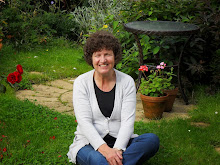
A friend is always helping other people, never himself. Someone sends him a fax or phones him asking can he give up three days a week for six months as a voluntary helper running a mass attendance sporting event and he says, yes, I can do that. No pay, no problem. So his own home gets a bit neglected. I noticed his garden was ten feet deep in brambles and chose to do something about it, motivating him by saying he could use it for the benefit of others when it is finished and tidy.
I started with a plan and set about rooting some cuttings of low maintenance plants that would do well in a garden that appeared to be of plateau gravel topped with a thin layer of London clay. One row of Leylandii trees had been removed and another was due to go so the land was exceedingly dry and I thought my assessment of substrate and top soil was correct – a dry garden.
It was to have a hedge across the bottom of assorted evergreen shrubs with hebes, rosemary and lavender to the front and tall red tulips interspersed for Springtime focus. The backing shrubs, escalonia that has small flowers in deep pink and a tall spiky plant that has sprays of tiny white flowers followed by orange berries. This, along with the small leaved hebes, would give it distance and the greens would change like the banks of a river appear to change as you slip by in a rowing boat. It would also be very low maintenance to fit the requirements of a man who would rather not be maintaining his own garden.
To the right I envisaged planting a row of evergreen rosa rugosa that would flower in pink to pick up the dotty pink or red from the high lower border.
To the left I saw only brambles, and a few self seeded plum stalks around an apple tree then being strangled by ivy. The sun bakes the south facing garden and I guessed that side would be dry – a row of silver leaved senecio would do nicely there if he could be persuaded to cut across the top of it with his electric hedge trimmer once a year. Grey green to the right, three feet high; assorted green with red and pink dots to the back; and dingy green with dull pink to the right – it would look fantastic if he once again mowed the lawn in the middle as he had before the brambles took over the ground and other people took over his spare time. I ordered masses of weed suppressant fabric to cover each patch of ground I exposed to stop the weeds coming back with pegs to hold it down. Not enough pegs – I frequently had to go for more.
I set about with this image in mind. Chopping the brambles was hot work but good balance exercise for my wobbly legs. Snipping up the lengths of stem was simple while were still fresh and soft, and gathering all the bits onto a cleared area that needed more height was easy with a rake.
And that was where the trouble started.
I wrenched at a roll of prickly stems, now reduced from ten feet to four. It stuck and I pulled harder. The roots of the brambles came out of good black soil like string out of honey right across to the fence on the other side. Not London clay and not dry. However, the brambles grew over my head as I thought about that so back to chopping I went. At the right hand fence I found the remains of an old fence piled up on top of and among faded children’s toys and garden rubbish. Rolling that away I found the base of the bramble den and tugged them out, returning to rescuing other areas of land from ivy that was rooted under the fence pieces. Baby frogs grunted their despair as I covered the land with black stuff and I spent hours catching them up and returning them to an old pond I had exposed near the house. They spent the time hopping back again until I came across their mother and caught her up. While I went on another tea break in the shade the frogs all hopped back onto the black stuff and tried to make holes in it. They were not on my side. They had their own agenda and ran an organised campaign.
Eventually the whole area was clear and mostly covered in black fabric, lumps appeared and fell back as brambles tried to see the sun again. I snipped them as they emerged from frog splittings and pinned the gaps over assiduously.
Months later the time for planting happened, though the 1970’s trailing ivy eating the garage roof was still thriving in spite of having been sprayed with the most evil bad plant killing stuff I could buy.
Throwing the pointy-ended pickaxe into the soil as it trying to make a hole in gravel worked better than expected and the right hand side was soon being planted with seneccio – far too easily. That soil was not the dry thin clay that seneccio would love, it was black rich soil wringing wet as if over the leaking water main!
I explored. The neighbouring garden was a few feet higher and their greenhouse was next to the wet area so it was assumed that he was watering with a leaking system. Wrong.
He was not.
I had found one more of the natural springs that are common high on plateau gravel. The springs that came up and vanished and are the bane of local water suppliers who keep being called out on reports of burst water mains when the road is flooding only to find after much digging that their water main is fine. The springs that make sloping roads into ice rinks in winter. But this one was round the back and was about to kill my chosen plants with root rot.
I suggested hydrangea but the man who owns the garden does not like them. I suggested Kniphofia (red hot pokers) but he does not like those either.
I suspect that part of the garden might end up as a water feature.
Further research suggests that land now part of a housing estate was the orchards and vegetable gardens of the gardener of a big estate whose mansion and stable block is now a large school for boys. Obviously the gardener used the stable manure on his own patch and with gusto. Brilliant soil that would grow anything bigger and better than anywhere else around and he just wants a low maintenance border. But of what? Bamboo would be even more uncontrollably invasive as the brambles I spent months fighting.
I think it might be box, buxus buxus. Too bright, too short, and too dark.
Garden design was never meant to be easy.
Monday, 7 December 2009

Thursday, 3 December 2009
Monday, 30 November 2009
the forthcoming demise of the cheque.
Regarding cheque payments and their forthcoming demise - which is a serious problem for local councils and charities whose articles of association dictate they must have two signatures for every payment.
The law will be changed and until it is they say it is down to individual councils to find ways of dealing with the situation.
I suggest that a payment card or credit card may be used providing the clerk has a numbered form, signed by two as now, filled in approving a payment, either with the exact amount or a No More Than specified for each usage. These forms would be filed as legal documents in the same way as cheque stubs are now, but with the serial number of the form listed in place of the cheque number as we do now. Reconciliation of payments would be made in the same way as current account reconciliations are now. These Electronic Payment Approval Forms (EPAFs) may be the system for the future of parish councils and charities. It is possible we need to design a form and pay attention to possibilities of fraudulent usage, though I see little opportunity for that happening. It also needs to have a name that gives us a catchier acronym.
Preventing a fictitious rogue clerk or charity tearsurer somewhere in the future taking advantage of any payment system needs to be tested.
The law will be changed and until it is they say it is down to individual councils to find ways of dealing with the situation.
I suggest that a payment card or credit card may be used providing the clerk has a numbered form, signed by two as now, filled in approving a payment, either with the exact amount or a No More Than specified for each usage. These forms would be filed as legal documents in the same way as cheque stubs are now, but with the serial number of the form listed in place of the cheque number as we do now. Reconciliation of payments would be made in the same way as current account reconciliations are now. These Electronic Payment Approval Forms (EPAFs) may be the system for the future of parish councils and charities. It is possible we need to design a form and pay attention to possibilities of fraudulent usage, though I see little opportunity for that happening. It also needs to have a name that gives us a catchier acronym.
Preventing a fictitious rogue clerk or charity tearsurer somewhere in the future taking advantage of any payment system needs to be tested.
Sunday, 29 November 2009
Star Wars revelation
On Star Wars movies there are floors on different levels, mezzanines all over the place, but no railings or bannisters to prevent anyone inadvertantly stepping over the edge.This implies all the Elf n Safety people have been rounded up and thrown into a very deep burning pit, maybe to have their entrails fed to giant mechanised camels. But who did that? Was it the Jedi Knights (good guys) or the followers of the Dark Side (baddies)?
I contend that the Elf n Safety proletariat had exceeded acceptable standards and interfered so much in people's lives and comon sense risk apprehension that the good guys were summoned to do this as an act of liberation.
I contend that the Elf n Safety proletariat had exceeded acceptable standards and interfered so much in people's lives and comon sense risk apprehension that the good guys were summoned to do this as an act of liberation.
Tuesday, 24 November 2009
Iraq war inquiry
I feel the whole topic of the Iraq war is very very distressing. I said at the time it was wrong to go to war with no exit strategy, with no plans for the welfare of the population we were to invade and take over the governance of, and with our armed forces equipped for Northern European operations only. To my mind this was illegal in itself. It was tantamount to the attenpted murder of our people in uniform. And sending them to a war we had no gain from, on a lie, saying it was not for regime change when it clearly was, and always has been. Blair even claiomed success in achieving regime change as justification for going to war in the first place so he did acknowledge that had been his objective - an objective outlawed by the United Nations on whose paperwork they used to send our forces in.
Wednesday, 11 November 2009
That letter and the PM’s eye.
That letter and the PM’s eye.
OK, look at it this way. The PM has ordered a generation into a war that carries no chance of victory, knowing if they come back they will see there are no jobs for the young generation he under-equips them so more get killed or maimed. But before bedtime he is told he must write letters to loved ones of all who died that day as a result of orders he gave. He threw the printer out of the room in a fit of temper and is now banned from access to printers, and keyboards, and pointy things like pens and pencils - all he has to do the job with is felt tipped pens and some headed writing paper. So he rushes off a few and leaves the room for others to do the folding and the posting. Knowing how violently explosive he has become they would not dare suggest maybe he has done it not well enough.
Then he finds the letter is doing his reputation no good at all and phones the recipient to keep her quiet, make her sorry she sent it to the press. She records it and quick as blinking the words are all over the Internet, would have been all over TV and radio if his organisation had not managed to frighten broadcasters into not broadcasting his voice on the tape.
What will he do next? What can he do?
There is his monthly press briefing coming up that same week, his one next chance to get away with having blotted his copybook, so to speak. His eyesight is poor, and like many others he has been attending the eye clinic and using the drops they tell us to use. The solution in that eye medicine is not exactly the same Ph as that of the eye so when we apply the drops it makes a stinging sensation that soon passes, but generates eye watering for a few minutes. With a flash of inspiration he puts the eye drops into that one good eye he has been told to apply it to, steps through the curtain into the public gaze with one eye still glistening. Right across the nation people with nothing better to do see him of their screens with one weeping eye. His reputation goes up. He is safe for another day – but the young people in the services are not, and the young people queuing in abject futility for every job vacancy are growing depressed and angry.
Keep using the eye drops, Gordon; you must know the side effects will give you cataracts and an excuse for leaving that job without crawling away in ignominy!
What you or I would have done is this. Having been informed that a young man, someone’s son or husband, has died as a result of following orders you initiated you know you have a duty to write to those who are grieving to let them know you are sorry for what happened. That you are sorry the consequences of your decisions led to the death of another highly trained and committed young man. You take a walk and sort out in your mind how to say what you have to say, figure out what would be the best choice of words, and think through the effect that wording will have on the recipient. Then you sit down at the desk and take up the selected writing implement. You look at the blank piece of paper, a lump developing in the throat and hand shaking, you know this had better be done right, no mistakes will be forgiven in a letter craving forgiveness. Getting the line straight you start moving the pen on the paper, so hesitantly that blots soon appear and that sheet of paper is crumpled up and dropped into the bin. On a piece of notepaper you scribble out the text, edit it and amend it and then you start again with the best ink pen on best paper, painstakingly forming every word in line and properly spaced, properly spelled. When it is done you hold it up and imagine yourself as the bereaved recipient, asking yourself if this good enough. If you decide not you do it all again. Then you have it checked over by one of the many secretaries ranked throughout the building. Only then would you fold it into the addressed envelope and place it carefully in the post out box on the sideboard by the door and get on with ending the day.
OK, look at it this way. The PM has ordered a generation into a war that carries no chance of victory, knowing if they come back they will see there are no jobs for the young generation he under-equips them so more get killed or maimed. But before bedtime he is told he must write letters to loved ones of all who died that day as a result of orders he gave. He threw the printer out of the room in a fit of temper and is now banned from access to printers, and keyboards, and pointy things like pens and pencils - all he has to do the job with is felt tipped pens and some headed writing paper. So he rushes off a few and leaves the room for others to do the folding and the posting. Knowing how violently explosive he has become they would not dare suggest maybe he has done it not well enough.
Then he finds the letter is doing his reputation no good at all and phones the recipient to keep her quiet, make her sorry she sent it to the press. She records it and quick as blinking the words are all over the Internet, would have been all over TV and radio if his organisation had not managed to frighten broadcasters into not broadcasting his voice on the tape.
What will he do next? What can he do?
There is his monthly press briefing coming up that same week, his one next chance to get away with having blotted his copybook, so to speak. His eyesight is poor, and like many others he has been attending the eye clinic and using the drops they tell us to use. The solution in that eye medicine is not exactly the same Ph as that of the eye so when we apply the drops it makes a stinging sensation that soon passes, but generates eye watering for a few minutes. With a flash of inspiration he puts the eye drops into that one good eye he has been told to apply it to, steps through the curtain into the public gaze with one eye still glistening. Right across the nation people with nothing better to do see him of their screens with one weeping eye. His reputation goes up. He is safe for another day – but the young people in the services are not, and the young people queuing in abject futility for every job vacancy are growing depressed and angry.
Keep using the eye drops, Gordon; you must know the side effects will give you cataracts and an excuse for leaving that job without crawling away in ignominy!
What you or I would have done is this. Having been informed that a young man, someone’s son or husband, has died as a result of following orders you initiated you know you have a duty to write to those who are grieving to let them know you are sorry for what happened. That you are sorry the consequences of your decisions led to the death of another highly trained and committed young man. You take a walk and sort out in your mind how to say what you have to say, figure out what would be the best choice of words, and think through the effect that wording will have on the recipient. Then you sit down at the desk and take up the selected writing implement. You look at the blank piece of paper, a lump developing in the throat and hand shaking, you know this had better be done right, no mistakes will be forgiven in a letter craving forgiveness. Getting the line straight you start moving the pen on the paper, so hesitantly that blots soon appear and that sheet of paper is crumpled up and dropped into the bin. On a piece of notepaper you scribble out the text, edit it and amend it and then you start again with the best ink pen on best paper, painstakingly forming every word in line and properly spaced, properly spelled. When it is done you hold it up and imagine yourself as the bereaved recipient, asking yourself if this good enough. If you decide not you do it all again. Then you have it checked over by one of the many secretaries ranked throughout the building. Only then would you fold it into the addressed envelope and place it carefully in the post out box on the sideboard by the door and get on with ending the day.
Saturday, 7 November 2009
Taxing risk takers out of the markets.
If this government goes ahead with confiscating the rewards of risk taking in financial transactions I will take all my money off the stock market immediately and leave it off until they see sense. I already pay stamp duty every time I buy shares. Government tax revneues depended on the City making money but government took away the regulating mechanism that worked and then abolished our own Glass Spiegal rules - thus killing the goose that laid the golden egg.
No extra taxes or we risk takers and investors go on strike.
No extra taxes or we risk takers and investors go on strike.
Subscribe to:
Posts (Atom)